Mini Test: Sigma 35mm f/1.4 DG II Art
Posted on May 6, 2026 by Pro Moviemaker
The fast 35mm prime has long been one of the most important lenses in any filmmaker’s arsenal. It sits in the sweet spot between wide and natural, offering an angle of view many say is equivalent to the human eye, giving context without distortion and offering intimacy without compression. With the new 35mm f/1.4 DG II Art, Sigma revisits an iconic lens and refines it for today’s hybrid shooters.
The result is a lens purpose-built not just for photographers, but also for filmmakers who demand speed, reliability and cinematic rendering in a compact, practical form.
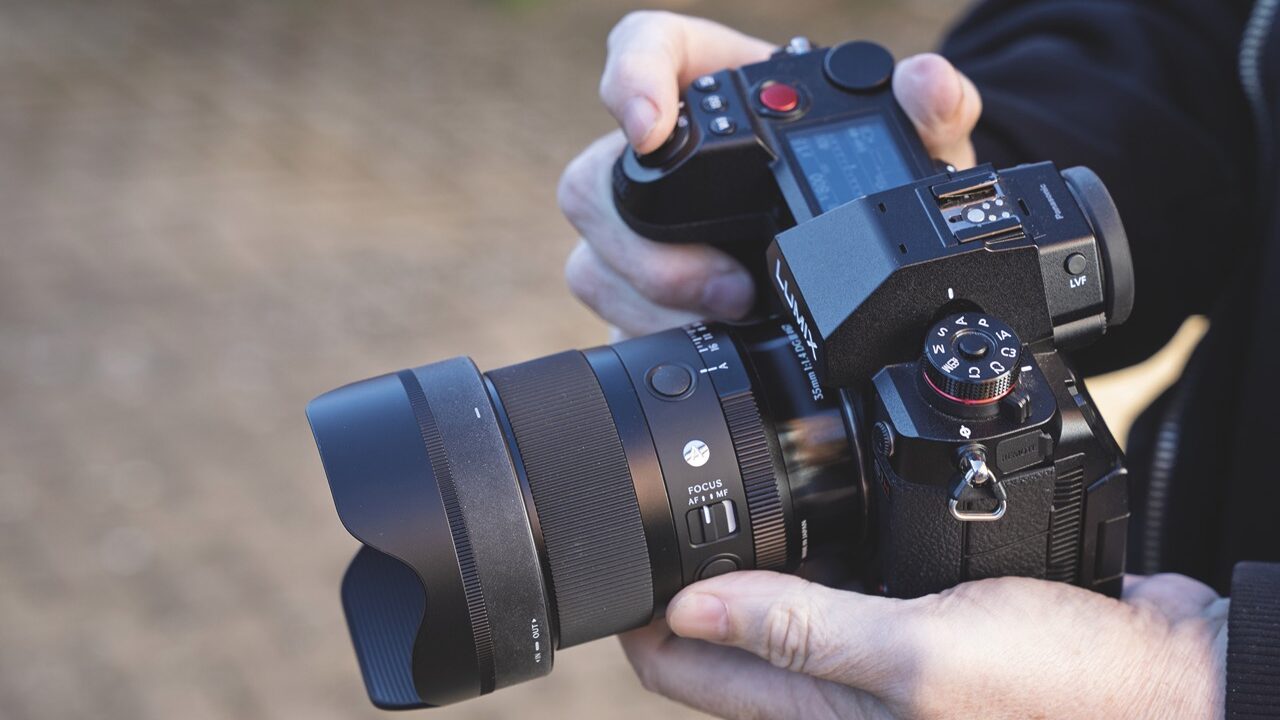
One of the Mark II’s biggest changes is its reduced size and weight. Sigma has managed to make the lens around 20% lighter and significantly shorter than its predecessor. This is thanks to a redesigned optical system and floating focus design. At 525g/1.16lb, it is ideal for handheld work and gimbal use.
Build quality remains classic Sigma Art – solid, premium and confidence-inspiring. The lens uses a combination of aluminium and thermally stable composites, with dust and splash resistance for real-world shooting conditions. For working outdoors or in unpredictable environments, that really matters.
Controls are also video-friendly. Previous versions already featured a de-clickable aperture ring, custom buttons and weather sealing. Sigma has continued to refine that tactile, mechanical feel. It’s a lens that feels like a tool, not a toy.
Autofocus performance is a key upgrade. The new version uses Sigma’s HLA (High-response Linear Actuator) motor, delivering faster and quieter focusing. That translates into smooth transitions and minimal focus noise, which is crucial for dialogue scenes or run-and-gun shooting.
Equally important is Sigma’s effort to reduce focus breathing, a common issue with fast primes. This makes the lens far more usable for narrative work, where subtle reframing during focus pulls can be distracting.
Manual focus is precise and well damped, making it viable for controlled filmmaking set-ups. Combined with its lighter build, this is a lens that works just as well on a follow focus rig as it does on a gimbal.
But image quality is where the Sigma really shines. Sharpness has always been a strength of the Art series, but the Mark II pushes it further. There is sharp centre detail even wide open at f/1.4, with excellent contrast and clarity. That sharpness falls off slightly at the corners, of course, but not by much.
For filmmakers, this level of consistency across the frame is critical – especially when composing for wide shots or shooting in high-resolution formats such as 6K or 8K. Stopping down improves contrast slightly, but the key takeaway is that you can shoot wide open with confidence – just what you want from a fast prime.
A 35mm lens isn’t typically chosen for extreme background blur, but at f/1.4, the Sigma can deliver strong subject separation and smooth, pleasing bokeh.
The 11-blade aperture produces rounded highlights and a more refined rendering than earlier versions. Out-of-focus areas feel natural rather than overly stylised, which suits narrative and documentary work alike.
For filmmakers, this translates to a cinematic look that feels polished without being distracting. It is ideal for interviews, environmental portraits and storytelling scenes where context matters. Sigma has clearly focused on correcting the weaknesses that are most crucial in video work.
Chromatic aberration is well controlled, even in high-contrast scenes, while distortion is minimal and easily manageable in post. Flare resistance is also improved thanks to Sigma’s new Advanced Amorphous Coating (AAC), which reduces ghosting and maintains contrast in challenging lighting. Vignetting is just about visible at f/1.4, but it improves quickly when stopping down. In practice, however, many filmmakers will see this as a potential stylistic advantage rather than a flaw.
What makes this lens particularly appealing is how well it fits into contemporary production.
The combination of compact size, reduced weight and strong optical performance makes it ideal for solo shooters and small crews. It balances well on mirrorless bodies, works easily on gimbals and doesn’t demand heavy support rigs.
Its focal length also makes it incredibly versatile. A 35mm is often the lens you leave on the camera when you don’t know what’s coming next. It delivers results that feel cinematic without requiring heavy grading or correction in post.
The Sigma 35mm f/1.4 DG II Art is a refinement of one of the most important lenses in filmmaking. If you feel the need for something even faster, Sigma also offers an f/1.2 version, but this does not come penalty-free. It is heavier and almost twice the price.
This f/1.4 version is still plenty fast. It’s also sharp, light, better-controlled optically and more video-friendly than before. Autofocus is fast, focus breathing is reduced and the overall handling is improved for real-world use. If you’re looking for a fast, reliable, cinematic prime that can handle everything from documentary to commercial work, this is about as close to a default lens as it gets.


Specifications
- Mount: Sony E, Leica L
- Image coverage: Full-frame
- Aperture: f/1.4-16
- Aperture blades: 11 rounded
- Construction: 15 elements in 12 groups with 2 SLD and 4 aspherical elements
- Minimum focusing: 28cm/11.1in
- Filter size: 67mm
- Dimensions (wxl): 73x96mm/2.9×3.8in (Sony E)
- Weight: 525g/1.16lb
Pro Moviemaker rating: 10/10
It’s a seriously fast, sharp, light and portable lens that comes in at a very attractive price
Pros: Light and compact, with a fast aperture
Cons: No Canon or Nikon versions
This article was first published in the May/June 2026 issue of Pro Moviemaker