Mini test: DJI Mic 3
Posted on Dec 11, 2025 by Pro Moviemaker
DJI’s Mic 3 impressed in our tests with longer range, cleaner audio and clever new features – though the missing lav input may divide opinion
Words Adam Duckworth
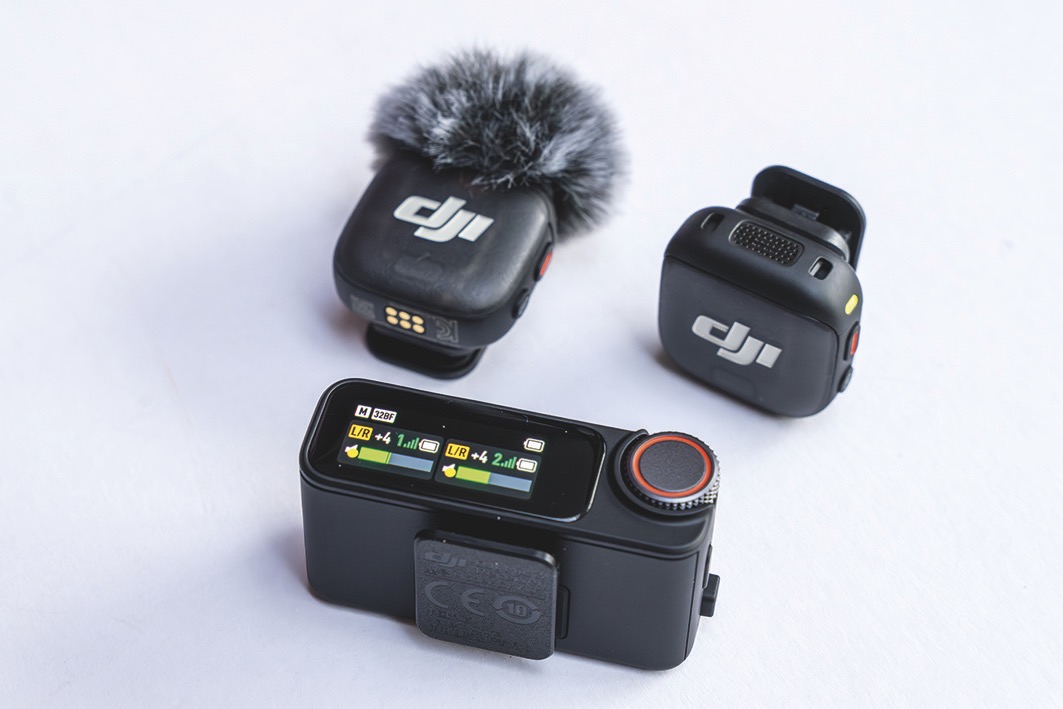
The popular DJI Mic 2 dual-channel wireless audio kit has been revamped into the new Mic 3 – and somehow the boffins have managed to make it smaller, cheaper and better in technology, capability, runtime and audio quality. The only retro step is the transmitters, now so small that there is no room for a lav mic input. Where the Mic 2 could be used with your own lavs, the Mic 3 has internal omnidirectional mics only.
But while the price has been shaved, the Mic 3 now offers support for up to four transmitters and eight receivers. In Quadraphonic mode, paired with compatible Sony software, you can record four independent audio tracks – ideal for panel discussions.
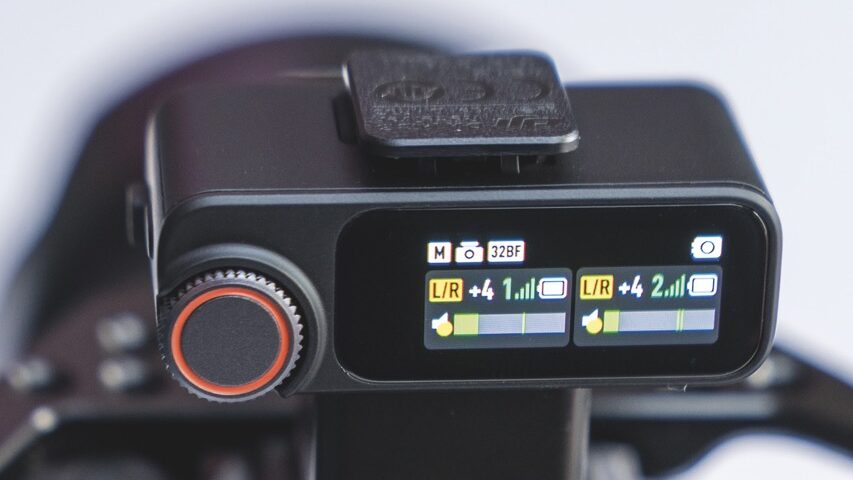
One of the biggest bonuses of the Mic 2 was that, with an adapter, it could be used entirely without cables on Sony cameras that have the Multi Interface (MI) Shoe, using a digital signal rather than a cable. Thankfully, the new Mic 3 retains this but there is a new £25/$34 adapter.
Each new transmitter weighs just 16g/0.03lb and can be worn with either a rotating clip or a magnetic mount, but the magnets aren’t very strong. DJI now offers windscreens in five colours too. Like previous kits, the all-in-one charging case is included, but this time the transmitters can be docked without removing clips or windscreens – a small change but a big improvement.
Adaptive Gain Control offers an automatic mode for suppressing spikes and a dynamic mode for balancing quieter environments. Three new voice tone presets – Regular, Rich and Bright – provide helpful templates and two-level noise cancellation helps tame background hum. These auto levels work well, as does setting manual gain via the dial on the camera-top receiver.
While the signal sent to the camera is a conventional 48kHz/24-bit, DJI has introduced dual-file 32-bit float internal recording with 32GB onboard storage per transmitter, saving both raw and enhanced versions. Each unit embeds timecode – that’s perfect for multicamera work.
Other upgrades include automatic frequency hopping across 2.4GHz and 5GHz for stable transmission up to 400m/1312ft – a huge increase over the Mic 2’s 250m/820ft range. The charging is quicker and runtimes last up to ten hours longer with the case.
We tried out the new Mic 3 at the IBC Show, where neither hundreds of various wireless-connected devices competing for bandwidth nor outside conditions fazed it. We also recorded backup 32-bit float, but the digital signal sent to our Sony A7S III and A1 was flawless.
There’s competition in the wireless audio market but DJI’s Mic 3 raises the bar, especially for Sony users.
Specifications
- Range: 400m/1312ft
- Frequency: 2.4GHz, 5.8GHz
- Interfaces: 3.5mm TRS audio output, headphone jack, USB-C, Lightning
- Built-in mic: Omnidirectional
- Max transmitters per band: 4
- Audio channels: 2
- Mic: Integrated
- Auto level/gain: Yes
- Sample rate: 48kHz/24-bit, 32-bit float (recorder)
- Battery life: 8 hours
- Charging time: 50 minutes
- Charging case: Additional runtime 28 hours
- Case charging time: 90 minutes
- Timecode: Yes
- Receiver dimensions (lxwxh): 53.9×28.7x22mm/2.1×1.1×0.9in
- Receiver weight: 25.1g/0.05lb
- Transmitter dimensions (lxwxh): 28.8×28.3×16.4mm/ 1.1×1.1×0.6in
- Transmitter weight: 16g/0.03lb
- Charging case dimensions (lxwxh): 106.3×59.2×42.5mm/ 4.2×2.3×1.7in
- Charging case weight: 200g/ 0.44lb
Pro Moviemaker rating: 9/10
An even smaller two-channel wireless audio system packed with tech
- Pros: 32-bit float recording
- Cons: No lav mic capability
This review was first published in the November/December 2025 issue of Pro Moviemaker