Gear: Panasonic’s S1 IIE
Posted on May 9, 2026 by Pro Moviemaker
Panasonic’s S1 IIE crams serious filmmaking tools into a practical hybrid that won’t break the bank
While most manufacturers compete on headline specs with faster burst rates, more megapixels or extreme frame rates, for many filmmakers and content creators the real priorities are far more practical. Considerations like reliable codecs, strong stabilisation, dependable AF and a workflow that integrates smoothly from capture to edit take priority. And, of course, the price!
That’s where Panasonic’s Lumix S1 IIE positions itself. Rather than chasing record numbers, it focuses on offering a balanced toolset aimed at real-world production, blending a 24.2-megapixel full-frame sensor with Panasonic’s video pipeline, flexible recording and a body built for long shooting days.
Positioned below the Lumix S1 II, which is a great all-round camera, the S1 IIE drops the faster semi-stacked sensor and some extreme stills burst capabilities, but keeps the core design, video features and handling hybrid shooters depend on. For many creators, that compromise and lower price makes the camera one of the most appealing entries in Panasonic’s growing L-Mount line-up.
A body designed to work
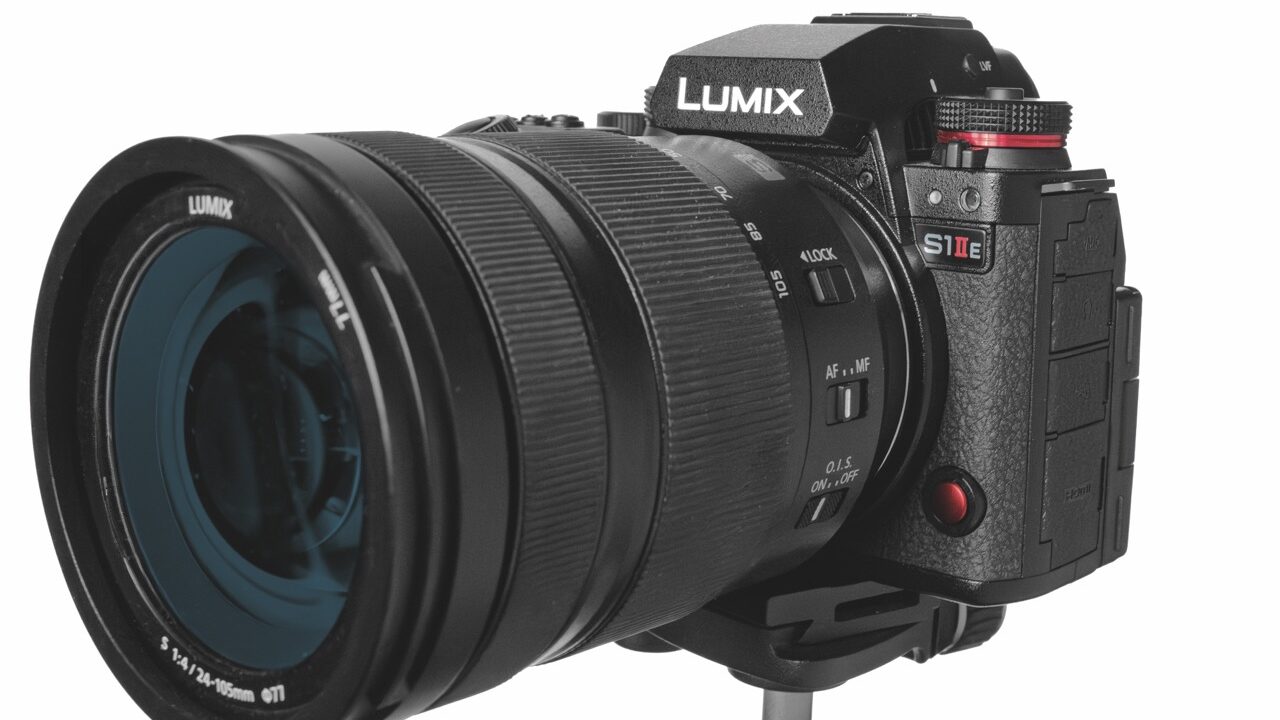
Pick up the Lumix S1 IIE and it feels like a professional tool rather than a compact content-creator camera. At 795g/1.75lb including battery and memory card, it’s heavier and chunkier than many mirrorless rivals, but that extra mass contributes to its stability and ergonomics.
Panasonic has long prioritised handling, and the S1 IIE follows that philosophy closely. The deep, sculpted grip provides a secure hold even with larger lenses, while the button layout is spacious and well defined. This makes it easier to operate the camera quickly without diving into menus, which is particularly useful when working under pressure on fast-moving shoots.
The body also uses Panasonic’s active cooling system. Vents and internal airflow enable heat to dissipate during long recording sessions, which helps maintain consistent performance when capturing high-resolution video. Unlike many hybrid cameras that rely solely on passive cooling, it’s designed with longer recording times in mind.
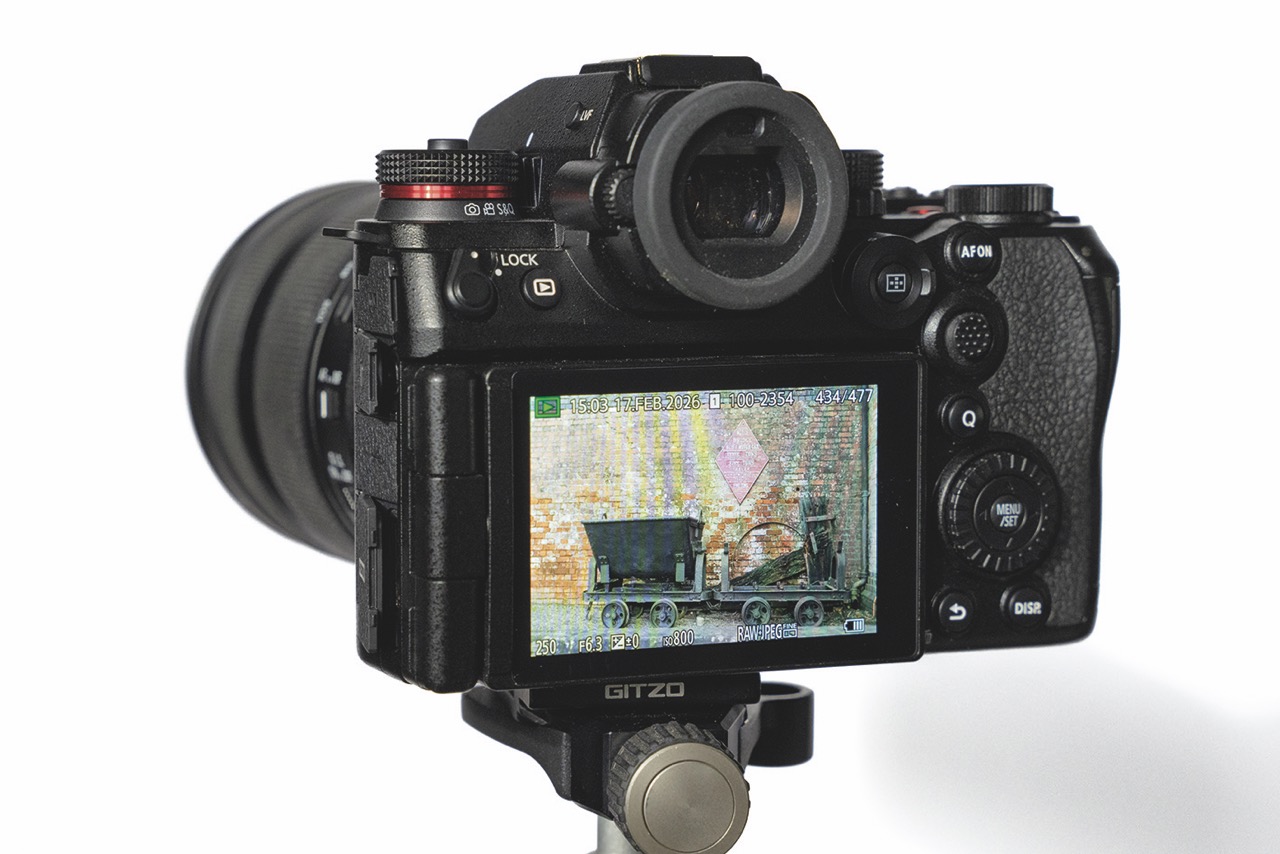
The rear LCD uses Panasonic’s tilt-and-free-angle design. It can flip out for vlogging or self-shooting, but also tilts while remaining centred behind the camera for traditional shooting. For hybrid creators moving between tripod work, handheld video and gimbal set-ups, this flexible articulation proves extremely useful.
The electronic viewfinder is equally impressive, offering a bright high-resolution display that makes framing and focusing comfortable even in strong sunlight.

The megapixel sweet spot
At the core of the Lumix S1 IIE is a 24.2-megapixel full-frame BSI CMOS sensor. While it lacks the newer and faster semi-stacked architecture found in the S1 II, it remains a highly capable imaging chip.
In fact, 24 megapixels continues to be a practical resolution for hybrid creators. It provides enough detail for commercial stills and editorial work while keeping file sizes manageable and allowing faster readout speeds than ultra-high-resolution sensors.
The sensor is paired with Panasonic’s Venus processing engine, delivering strong colour reproduction and tonal response. Panasonic’s colour science has always been popular among filmmakers, particularly for its natural skin tones and balanced contrast.
Dynamic range performance is equally impressive. The camera supports V-Log recording, which Panasonic delivers with more than 14 stops of dynamic range. In practical use, this provides significant flexibility when grading footage, especially recovering highlight detail or if lifting shadows in post-production.
Dual native ISO is another important feature for video shooters. When shooting in V-Log, the base ISOs of 640 and 4000 allow the camera to maintain clean image quality across a wide range of lighting conditions. This makes it easier to adapt to both controlled environments and low-light location work.
For stills photographers, the S1 IIE also supports HDR imaging through HEIF files using the HLG profile. These 10-bit stills provide an extended tonal range straight out of camera, offering an alternative to traditional Raw processing workflows.
Latest phase of focusing
In the past, autofocus performance has been a sticking point for Panasonic cameras, but all the recent models have made big progress since the use of on-sensor phase detection. The S1 IIE uses Panasonic’s Phase Hybrid AF system, combining phase detection points with contrast-based focusing to improve speed and tracking.
Subject detection modes include humans, animals, vehicles and Panasonic’s Urban Sports recognition system, which is designed to track subjects like skateboarders or cyclists.
In practice, the autofocus feels much more confident than older Panasonic systems. For hybrid shooters capturing events, weddings or documentary footage, the improved tracking reduces the need to constantly monitor focus manually.
The camera can also shoot stills at up to 30fps using the electronic shutter with continuous autofocus. While rolling shutter limitations mean it is not a dedicated sports camera, this burst capability is more than sufficient for many real-world scenarios.
Panasonic also includes a pre-burst capture mode, which records frames before the shutter is fully pressed. This can help capture unpredictable moments such as wildlife behaviour or spontaneous reactions during events.
A powerful video platform
Where the S1 IIE truly shines is its video capability. Panasonic has long been respected in the filmmaking community, and the S1 IIE inherits many of the features that have made Lumix cameras popular among professional videographers.
One of the most important is 6K open gate recording. Shooting in a 3:2 aspect ratio allows creators to reframe footage for different formats after capture. This is useful for content creators producing both horizontal and vertical video for platforms like YouTube, Instagram and TikTok.
Open gate recording allows the full sensor to be used, giving maximum flexibility in post-production without sacrificing composition options. The S1 IIE also supports both ProRes 422 and ProRes 422 HQ
internal recording, which is rare in cameras at this price. Recording ProRes internally means filmmakers can skip external recorders while still capturing high-quality, edit-ready files.
The camera also offers H.264 and H.265 codecs, including high-bit-rate All-Intra recording modes in 10-bit 4:2:2. These formats provide a good balance between file size and image quality, making them suitable for a wide range of production workflows.
For filmmakers seeking flexibility, the S1 IIE can also output ProRes Raw to compatible external recorders.
There’s also an option to shoot in Arri LogC3 via a paid software upgrade. This allows Lumix footage to integrate more easily into professional workflows where Arri colour pipelines are commonly used – although few shooters will be mixing Arri cameras with an S1 IIE B camera. Arri colours are famous though, so it’s great to get them out of an affordable camera even if it does cost an extra £179/$212.
The S1 IIE offers 6K up to 30p, 4K up to 60p and Full HD up to 180fps. These higher frame rates come with some limitations, including a reduced field of view and manual focusing only above 150fps.
Recording at the highest data rates requires CFexpress Type B cards, while lower-bit-rate modes can be recorded to the camera’s second SD card slot.
Stabilisation advantage
One area where Panasonic continues to lead the market is image stabilisation.
The S1 IIE has five-axis in-body stabilisation, which works alongside lens stabilisation when available. Panasonic’s stabilisation algorithms have long been praised for their ability to produce smooth handheld footage.
The camera also has electronic stabilisation designed to correct distortion while keeping the full field of view. Unlike many systems that crop the image significantly, Panasonic’s implementation aims to retain as much of the original frame as possible.
In real-world shooting, this makes handheld work far more practical. Documentary filmmakers, event shooters and content creators can often shoot usable footage without needing additional stabilisation gear.
This is particularly valuable for solo operators who need to move quickly between set-ups without constantly building or rebalancing rigs.
One L of an ecosystem
The S1 IIE is part of the L-Mount alliance between Panasonic, Leica and Sigma. Although lenses are not as widely available as Sony mounts, the ecosystem has matured in recent years, offering a wide range of lenses covering everything from compact primes to professional cinema optics.
Sigma’s extensive range of Art and Contemporary lenses provides good value for creators building a full-frame kit. Meanwhile, Panasonic’s own Lumix S lenses are designed with video in mind, offering smooth focus transitions and minimal breathing.
And as Canon’s RF system and Nikon’s Z mount continues to be a closed system for full-frame users, L-Mount now offers a real alternative for filmmakers who value optical quality and flexibility.
Since the Lumix S1 IIE is clearly designed for hybrid creators who shoot both stills and video rather than pro sports shooters, there are plenty of optical options now.
It’s ideal for wedding and event shooters as well as documentary filmmakers due to the camera’s stabilisation, dependable autofocus and codec options. Content creators benefit from open gate recording and internal ProRes, making it easier to produce footage for multiple platforms. At the same time, the camera remains capable for stills photography, delivering excellent dynamic range and colour reproduction.
Why go for the E-class Lumix?
Panasonic’s £1899/$2498 Lumix S1 IIE sits in an interesting position. It shares the rugged body, handling and many of the video tools of the £2599/$3198 Lumix S1 II and higher-resolution £2999/$3200 Lumix S1R II. But the E model trims back some of the more extreme specifications in favour of a lower price and a more balanced hybrid shooting experience. For many filmmakers and content creators, that compromise may actually make the S1 IIE the smarter buy for what they need.
The biggest difference between the S1 II and E models lies in their sensors. The Lumix S1 II contains a faster semi-stacked full-frame sensor designed to deliver very high burst rates and faster readout speeds. That enables features like ultra-fast stills shooting and reduced rolling shutter when using the electronic shutter or recording high-frame-rate video.
The S1 IIE instead houses a more traditional 24.2-megapixel BSI CMOS sensor – which is closely related to the one found in the Lumix S5 II. While it doesn’t match the flagship’s speed, it still offers excellent image quality, strong dynamic range and reliable performance for both stills and video. For the majority of filmmakers and hybrid shooters, the slower readout isn’t a deal breaker.
Where the two cameras are much closer is in their core filmmaking features. The S1 IIE still offers 6K open gate recording, which can capture the entire 3:2 sensor area. Additionally, both cameras support internal ProRes, high-bit-rate 10-bit codecs and external ProRes Raw output. For many different types of productions, this level of recording flexibility is far more important than headline frame rates.
In-body stabilisation is another area where both models benefit from Panasonic’s long-standing expertise. Autofocus performance is similarly strong as both use the same Phase Hybrid AF system with subject detection and tracking modes.
Where the S1 II still pulls ahead is its speed. It can shoot faster still bursts and provides higher-frame-rate video modes, making it better suited to demanding sports or wildlife photography. The faster sensor also aids in reducing rolling shutter in some scenarios.
However, those benefits come with a higher price. If your work doesn’t require the absolute fastest capture speeds, the S1 IIE offers nearly the same filmmaking capabilities in a more affordable package.
The Lumix S1R II takes a different approach again, focusing on resolution with a higher-megapixel sensor aimed at photographers who need maximum detail for commercial, landscape or studio work.
While the S1R II still offers strong video capability, its emphasis is clearly on still image quality rather than hybrid filmmaking performance.
For creators who shoot a mix of video and stills, the 24.2-megapixel sensor of the S1 IIE is often the more practical option. It produces smaller files, faster readout speeds and smoother video performance while still delivering more than enough resolution for most photographic work.
In short, the S1R II is best suited to photographers first, videographers second. The S1 II is the flagship speed machine and the S1 IIE sits neatly between them – arguably the most balanced hybrid camera in Panasonic’s current line-up.
It’s all about the lenses
One major hurdle for potential Panasonic buyers is that few will have lots of L-Mount lenses. There’s also lots of competition from other brands at a similar price to the £1899/$2498 Lumix S1 IIE, where creators are likely to already have some Canon, Sony or Nikon glass.
Sony’s A7 IV, Canon’s EOS R6 II and Nikon’s Z 6III are all in the same price bracket and relatively recent. For a bit more money, there’s Nikon’s ZR which is primarily a cinema camera that isn’t ideal for all-round use as it has no EVF.
But the Sony A7 IV, Canon EOS R6 II and Nikon Z 6III are all direct rivals as similar all-rounder mirrorless models, and none have a semi-stacked sensor for speed. If you want that speed, you need the Lumix S1 II. But if you can spend that much, the new Sony A7 V and Canon R6 III would come into consideration – or even the Canon C50 cine cam. It’s a packed market with some great tech.

Specifications
- Price: £1899/$2498 body only
- Sensor size: 23.8×35.8mm full-frame CMOS, 24.2 megapixels, dual base ISO. Formats: MOV/MP4/Long GOP/All-Intra/ ProRes/ProRes Raw/HQ, ProRes Raw 5.7K 29.97fps, H.265 Long GOP 4:2:0 8-bit 6K 29.97fps, H.264 All-Intra 4:2:2 10-bit DCI 4K 29.97fps
- Slow motion: C4K 120fps
- External recording: Raw 6K 29.97fps, 4K 50fps
- Dynamic range: 14+ stops
- Stills formats: HEIF, JPEG, Raw 10-bit in 1:1, 2:1, 3:2, 4:3, 16:9, 65:24
- Storage: 1x CFexpress Type B, 1x SD/SDHC/SDXC
- ISO range: 100-204,800. 50-204,800 extended. Dual base 100/640
- Shutter: Mechanical and electronic, 60secs-1/8000sec
- Drive modes: Up to 30fps
- Stabilisation: Five-axis sensor shift
- Lens mount: L
- Screen: 7.6cm/3in LCD free-angle articulating touchscreen, 1.84 million dots
- Viewfinder: OLED with 5760k dots, 120fps
- Connectivity: HDMI Type A, Bluetooth, Wi-Fi, USB-C, Lumix Lab app, Frame.io, RTMPS FHD streaming up to 60p
- Focusing: 779-area hybrid phase detection AF
- Dimensions (wxhxd): 134.4×102.3×91.8mm/ 5.29×4.03×3.61in
- Weight: 712g/1.57lb body only
The Verdict
The Panasonic Lumix S1 IIE may not chase the most extreme specifications, but it excels in the areas that matter most to real-world filmmakers and creators.
With a full-frame sensor, strong stabilisation, flexible recording formats and powerful internal codecs, it delivers a hybrid shooting experience that feels both practical and professional.
Add open gate 6K recording, better autofocus and Panasonic’s well-established video pipeline, the result is a camera that fits into modern production workflows. For creators who need a reliable hybrid tool, not just a spec-sheet showpiece, the Lumix S1 IIE might be the smarter choice.
Features: 9
Great AF, ProRes Raw internal shooting and 6K open gate
Performance: 9
The footage excels, especially if you add on the Arri option
Handling: 9
A chunky build, although solid, and the complex menus are easy to navigate
Value for money: 9
It’s not the flagship but offers almost the same spec for less cash
Pro Moviemaker overall rating: 9/10
A great-value full-frame Lumix ideal for shooting video
Pros: Lots of high-quality codecs, great build quality
Cons: No fully stacked sensor or superfast 240fps
Visit panasonic.co.uk for more information
This article was first published in the May/June 2026 issue of Pro Moviemaker